Due to the strong number of contributions received, AIPV is now planned as a two-day event, taking place from May 18 to May 19. Please take this into account when making your travel and accommodation arrangements.
⚠️ Regarding Participation:
AIPV is planned as an in-person workshop. Remote presentations are not a standard option and will only be considered in exceptional cases upon prior agreement with the organisers. Thank you for your understanding.
AI, Proof and Verification 2026 (AIPV2026)
| Collocated with FM 2026 | May 18–19, 2026 | Tokyo, Japan |
Table of Contents
- About AIPV
- Organization
- Local Organising Team
- Administrative Support
- Sponsor (Partner)
- Dates
- Venue
- Contact
About AIPV
Artificial intelligence and machine learning have shown remarkable progress in recent years, particularly through large language models (LLMs) and neural approaches. Yet despite their successes in natural language processing and perception tasks, reasoning remains a major open challenge for AI. LLMs are not inherently good at rigorous reasoning: they can generate plausible but invalid arguments, lack guarantees of soundness, and often fail on tasks requiring compositional or symbolic inference. This creates both an opportunity and a challenge: theorem proving and formal verification provide precisely the kind of rigorous environment where AI methods can be stress-tested, improved, and guided towards more trustworthy reasoning.
At the same time, the gap between the AI community (AAAI, NeurIPS, ICML, IJCAI) and the logic/theorem proving/verification community (FM, CAV, FMCAD, CADE, ITP, IJCAR) remains wide. The differences are not merely technical but also cultural — from evaluation criteria, benchmarks, and publication norms, to expectations about rigor versus empirical performance. This culture gap impedes knowledge transfer and slows down progress at the intersection. A dedicated forum that lowers this barrier can accelerate mutual understanding and collaboration.
Even within the logic-based communities themselves there is diversity: different proof assistants, logics, and verification frameworks (e.g., higher-order logics, dependent type theories, SMT-based systems, model checkers) present different challenges for AI integration. Some require guiding interactive proof search, others demand scaling verification of complex hardware/software systems, and others seek reliable translation between informal and formal representations. Bringing together researchers across these different traditions is essential to identify commonalities, share successes and failures, and shape a coherent research agenda.
The AI for Proof and Verification (AIPV) addresses precisely these needs. By gathering researchers from theorem proving, formal verification, and AI/ML, it provides a forum to:
- Critically assess the capabilities and limitations of current AI/LLM approaches for rigorous reasoning.
- Share experiences across different logics and verification frameworks.
- Bridge the culture gap between AI and logic-based communities through dialogue and collaboration.
- Chart new directions for AI-assisted formal reasoning that balance scalability with soundness and trust.
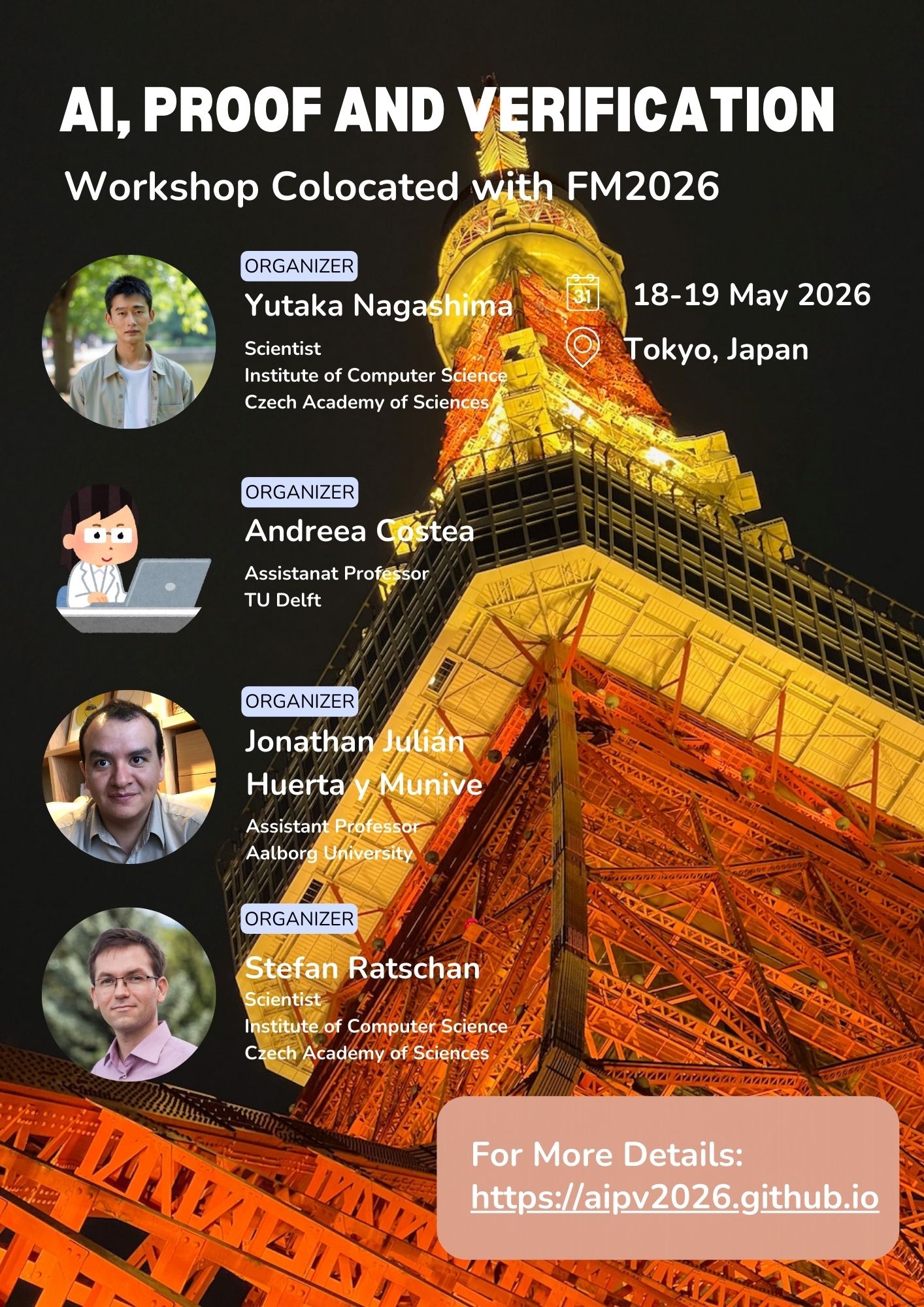
Organising Team
- Yutaka Nagashima at the Czech Academy of Sciences
- Jonathan Julián Huerta y Munive at Aalborg University
- Andreea Costea at TU Delft
- Stefan Ratschan at the Czech Academy of Sciences
 Link to the page of Yutaka.
 Link to the page of Jonathan.
 Link to the page of Andreea.
 Link to the page of Stefan.
Local Organising Team
- Minchao Wu
- Kensho Tsurusaki at the University of Tokyo and the National Institute of Informatics
- Yutaka Nagashima at the Czech Academy of Sciences



Review Team
- Andreea Costea at TU Delft
- Jonathan Julián Huerta y Munive at Aalborg University
- Yutaka Nagashima at the Czech Academy of Sciences
- Stefan Ratschan at the Czech Academy of Sciences
- Stefan Nugraha at the Czech Academy of Sciences
Link to the page of Andreea.
Link to the page of Jonathan.
Link to the page of Yutaka.
Link to the page of Stefan.
 Link to the page of Stefan.
Administrative Support
The administrative and financial operations of AIPV 2026 are supported by ASTER (Association for Software Test Engineering and Research), which kindly assists with sponsorship processing and financial management for the workshop.

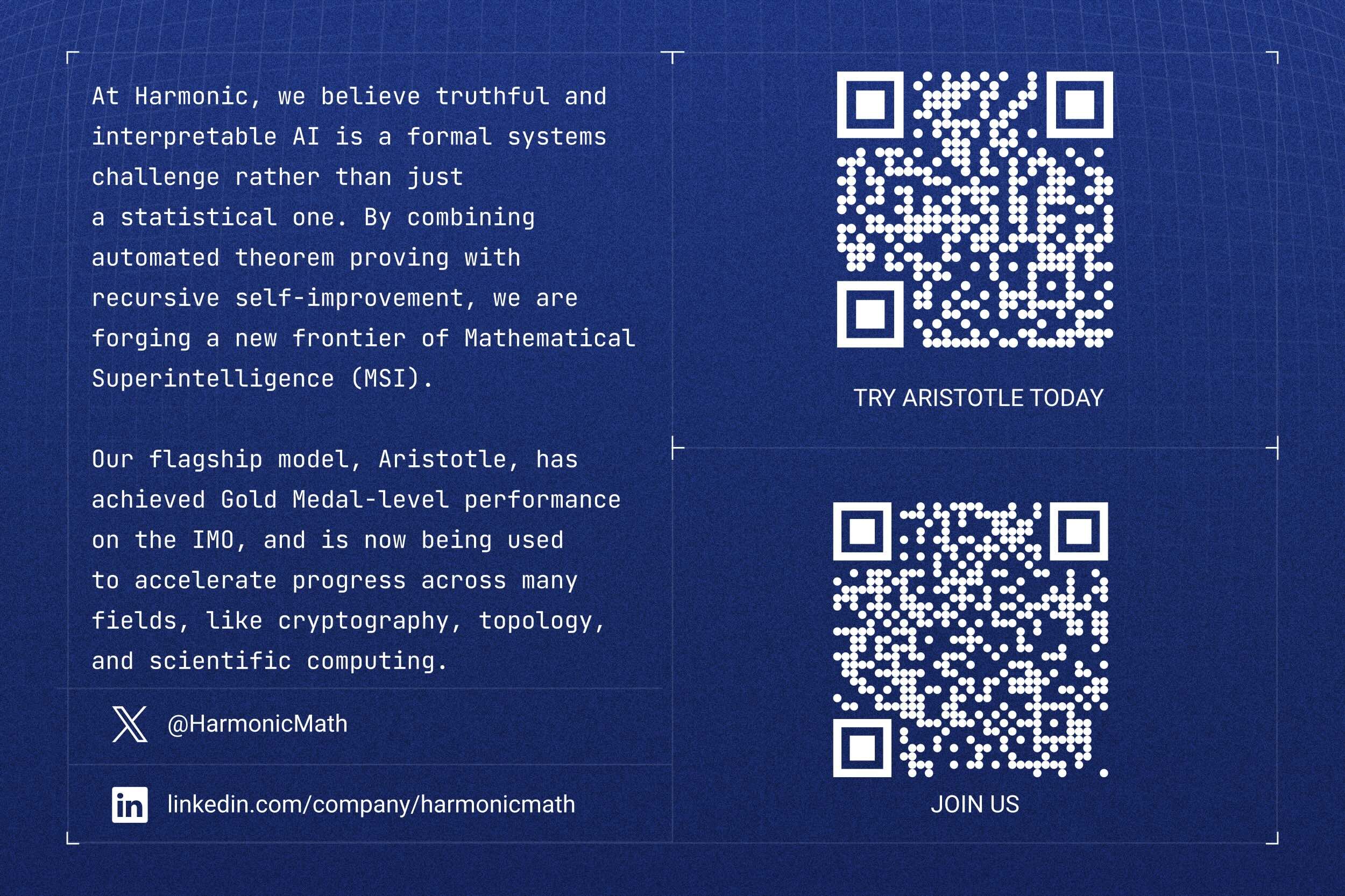
Sponsor (Partner)

Important Dates
The following is the tentative timeline of AIPV
Workshop paper/abstract submission: March 15 2026 (23:59 AoE)- Notification of acceptance: April 15 2026 (23:59 AoE)
- Early registration deadline: April 18 2026
- Camera-ready submission: April 30 2026 (23:59 AoE)
- Workshop date:
One dayTwo days before FM 2026 (May 18-19 2026)
Venue
AIPV2026 will take place at Hitotsubashi Hall in Tokyo, Japan.
Submission
The submission deadline has passed, but inquiries about possible contributions are welcome. Please contact the organiser at nagashima+cs.cas.cz (replace + with @).
Contact
The main point of contact is Yutaka’s email address: nagashima+cs.cas.cz (replace + with @).